Why Williamsport Yards Stay Wet
Because this valley collects water faster than its soils can pass it through. Williamsport takes more than 40 inches of precipitation a year — plus roughly 33 inches of snow that all has to melt somewhere — and much of it lands on slow-draining, clay-over-shale valley soils that hold water near the surface instead of letting it soak away.
That's why a yard here can stay squishy for days after a storm that a sandier region would shrug off in an afternoon. The water isn't gone; it's parked — perched on tight subsoil with nowhere to go. Add a lot graded flat (or worse, leaning toward the house) and downspouts feeding roof water into the same ground, and "always wet" stops being a mystery. It's plumbing the lot never had.
The Levee Protects the City — Not Your Yard
Williamsport's levee holds back the West Branch of the Susquehanna. It does nothing about the water falling on — and creeping through — your own lot. The Army Corps levee, finished in 1955, guards Williamsport, South Williamsport, Old Lycoming, and Loyalsock; during Agnes in 1972 the river crested at 34.75 feet against a 20-foot flood stage, came within about a foot of the levee's top, and held. The Sun-Gazette has put the real estate behind it at up to roughly $5 billion.
But this county's hardest water lessons came off the creeks, where no levee stands. The 1996 flood ran about two feet higher on Lycoming Creek than Agnes had on that same creek, and six people died. In 2011, Tropical Storm Lee set the record crest on Loyalsock Creek — a creek event, not the main river — washing out the PA-973 bridge along the way. If your property drains toward Lycoming Creek or Loyalsock Creek country, grading and drainage aren't landscaping. They're your infrastructure, because the levee was never built for you.
French Drain, Swale, or Regrade?
Surface water that flows calls for a regrade or swale. Water that sits, or rises from below, calls for a french drain. Chronic problems usually take a combination. Here's what each tool actually is:
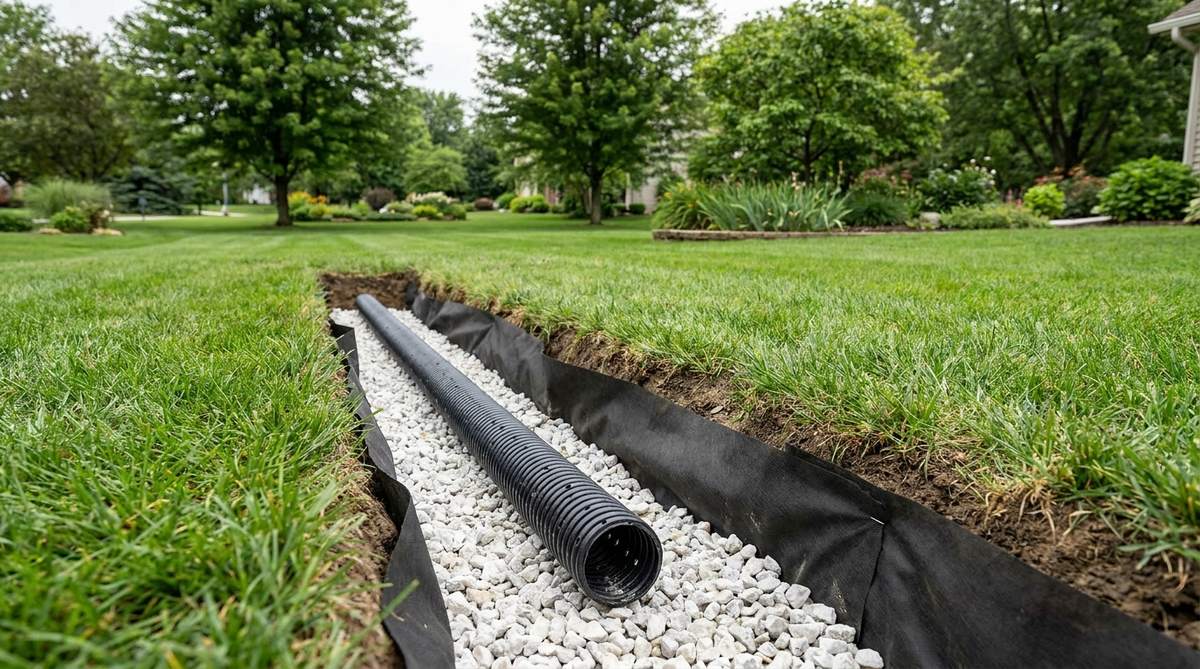
- French drain. A fabric-lined trench with perforated pipe bedded in washed stone — it collects water already in the ground and carries it to daylight. The fix for saturation and standing water.
- Swale. A shallow, grassed channel graded into the yard that intercepts surface flow and steers it around what you're protecting. Nearly invisible when done right.
- Regrade. Reshaping the ground so water never collects in the first place — the source-level fix when the yard's shape is the problem. Details on our grading & site preparation page.
Because we do all three, the recommendation follows the water, not the product line. A drain-only company sells you a drain; a landscaper sells you a regrade. We'll tell you which one your water actually calls for — and when the honest answer is both.
Downspout Tie-Ins
A surprising share of the "mystery" water in a wet yard comes off the roof. Every storm concentrates the water from your entire roof into four or five downspouts, and if those discharge at the foundation or into an already-soggy lawn, they're refilling the problem you're paying to fix.
The repair is buried solid pipe — not perforated — carrying each downspout's discharge well away from the house to daylight or a pop-up emitter. It matters that the pipe is solid: tying roof water into a french drain's perforated run injects water into exactly the trench that's supposed to be removing it. Downspout tie-ins ride along cheaply with any drainage or grading job, and on rain-driven basement problems they're often half the cure by themselves.
When It's Us — and When You Need a Basement Waterproofer
If the water reaches your basement from outside — grade, downspouts, saturated soil against the wall — that's us. If it's rising through the slab or the wall needs an interior system, that's a basement waterproofer, and we'll say so. That line matters, because the two fixes cost very different money and solve different problems.
Our side of the line is the yard: regrading ground that pitches toward the house, tying downspouts away from the wall, and cutting exterior drains that relieve the soil before water ever loads the foundation. When the outside work is genuinely done and water still shows up, an interior drain-and-sump system is the right call — and you'll hear that from us plainly, not after we've sold you another trench. Plenty of basements around here get dry without anyone ever cutting the slab; yours might be one of them.
What Yard Drainage Costs
Published national ranges put french drains at $10 to $100 per linear foot. That band is wide because the jobs are: a shallow lawn run to daylight sits near the bottom, while deep runs, difficult access, long discharge distances, and rock move a project toward the top — and on our shale ground, rock is always worth checking before anyone quotes.
Those are planning figures, not quotes. A real number takes a site walk: we trace where the water comes from, measure the run the fix actually needs, and hand you an itemized estimate that separates the drain, the discharge, the regrade, and the downspout work so you can see exactly what you're buying. The walk is free — call (570) 435-7565 or reach us through the contact page, and your yard can be on this week's schedule.