Sheds, garages, barns, and mobile homes torn down, loaded, and hauled away — one crew, one price, and a clean graded lot when the trucks leave.
Call (570) 555-0134Tell us what you're planning — a cleared lot, a dry basement, a new driveway, a septic replacement — and we'll walk the site, explain your options, and put a real number on it. Call (570) 555-0134.
If a structure on your property is past saving, we take it down and haul it away: collapsing sheds, garages that lean a little worse every winter, barns that stopped being safe years ago, and mobile homes that are beyond repair.
Sheds are usually the fast job — many come down, get loaded, and leave in a single visit. Garages take more planning, especially attached ones, where the demolition has to stop precisely at the house wall and leave it sealed and weathertight. Barns are the big variable: heavy timber frames, decades of stored contents, and often a structure the brush has half swallowed — where a barn site is overgrown, we pair the demo with land clearing so you end up with a usable lot, not just a missing barn.
Mobile homes are their own category. An older single-wide that's beyond repair usually can't be sold or moved economically — moving costs more than the home is worth — so it gets stripped, broken down, and hauled: steel frame and axles out, everything else loaded and disposed of properly. It's one of the most common demolition calls we get from rural Lycoming County properties and camp lots.
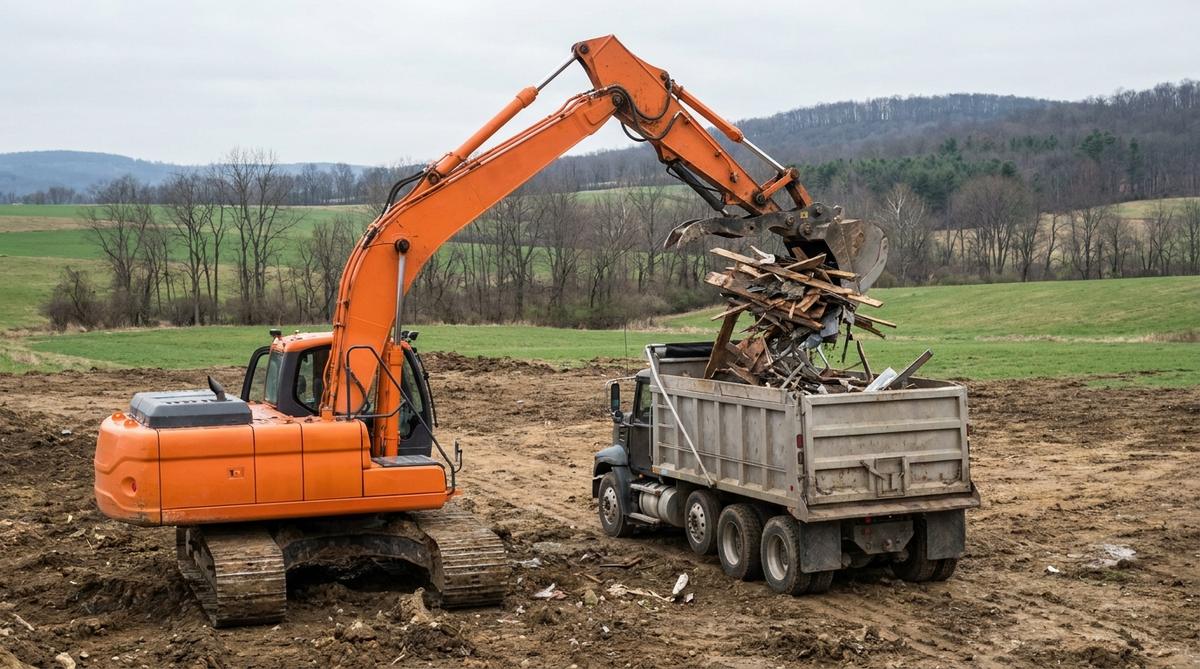
Every structure removal we quote covers the full job:
Nobody calls asking for "demolition services" — they ask to have something torn down and hauled away, and that's exactly how we quote it: one job, one number, nothing left behind.
The distinction matters because the cheapest demo bids often cover only the knockdown, and you find out later that the debris pile — somehow always bigger than the building was — costs as much to remove as the structure did to drop. Our estimates itemize machine time, loading, trucking, and disposal, then finish with a rough grade across the disturbed footprint. When we leave, you have a lot you can mow, park on, or build on.
Not always — and this is the follow-up question to ask on every demolition quote, because it's where two identical-sounding bids stop being identical. Plenty of contractors quote the structure only and leave the concrete in the ground.
Breaking up a slab or foundation, loading it, and hauling it is genuinely separate work — concrete is heavy, trucks differently, and is disposed of differently — so we carry it as its own line item you can take or leave. Sometimes keeping a sound slab is the smart move: if a new garage or shed is going on the same footprint, an intact level pad is an asset. But if you want the ground back, we break out the concrete, pull the footers, backfill the hole with compacted material, and grade it off — so the spot doesn't become the mystery dip in your yard three years from now.
Before anything comes down, two things have to happen: the municipality signs off, and the utilities come off the building. We run that sequence on every job.
Demolition permit requirements are set town by town across Lycoming County's boroughs and townships, so we confirm what your municipality requires before we schedule the machine — ask us and we can usually tell you what your township will want in one call. Utility disconnects are non-negotiable: electric service dropped and the meter pulled, gas capped, water and sewer — or the septic connection — properly capped off. And because pulling foundations means digging, Pennsylvania's One Call law applies: we file the 811 request and wait out the 3–10 business day marking window the law (Act 50) requires before excavating anything. That filing is our responsibility, not yours.
Published national ranges: shed removal runs about $250–$3,000, garage demolition about $2,000–$10,000, and mobile home removal about $4 per square foot — so a 14-by-70 single-wide, at 980 square feet, prices out near $3,900 by the published math.
| Structure | Published range | What moves it |
|---|---|---|
| Shed | $250–$3,000 | Size, contents, access, whether a pad goes too |
| Garage | $2,000–$10,000 | Attached vs. detached, size, slab & foundation removal |
| Mobile home | ~$4 per sq ft | Contents, decks and additions, piers, truck access |
Where a real quote lands inside those ranges comes down to size and construction, whether the slab and foundation go too, what's still inside the building, how close trucks and machines can get, and disposal distance. Every estimate we write itemizes the tear-down, the haul-away, and the concrete separately — so when you compare us against another bid, you're comparing the same scope of work, not guessing at what the other guy left out.
Clearing, grading, septic, drainage, or demolition — call now and get a real answer today, not a voicemail you never hear back from.
(570) 555-0134Published national ranges run about $4 per square foot for mobile home demolition and removal — roughly $3,900 for a 980-square-foot single-wide by that math. What moves the number: whether it's been emptied or is still full, whether decks, additions, skirting, or piers are attached, how close trucks can get, and whether a slab or pad goes too. Once a mobile home is genuinely beyond repair, demolition is almost always cheaper than trying to move or rehab it.
Published national ranges put garage demolition at roughly $2,000–$10,000. A small detached single-car garage with easy truck access sits near the bottom of that range; a large, attached, or hard-to-reach garage — or one where the slab and foundation come out too — climbs toward the top. Our quotes bundle the tear-down and the haul-away as one job and list slab removal as its own line, so you can compare bids honestly.
Ask — because it often doesn't. Many demolition quotes cover the structure only and leave the concrete in the ground. Removing a slab or foundation is separate work with its own trucking and disposal costs, so we price it as its own line item: keep the slab if it's sound and useful for what's next, or have us break it out, backfill with compacted material, and grade the spot off so it doesn't settle later.