Forestry Mulcher vs. Bulldozer: The Topsoil Question
The real difference isn't speed or price — it's what happens to your topsoil. A forestry mulcher grinds standing brush and trees into chips right where they grow, leaving the ground surface intact under a protective mulch blanket. A bulldozer pushes vegetation over and shoves it into piles — and tangled in those root balls goes several inches of the topsoil your land spent decades building.
On the thin, shaley Weikert and Berks soils that cover most of Lycoming County's hillsides, that trade matters more than usual: where bedrock can sit less than 20 inches down, there isn't much topsoil to give away. Mulching keeps it. To be fair to the dozer — when you're building and the stumps have to come out anyway, conventional land clearing with grubbing is the right tool, and we'll tell you so on the walk.
What a Forestry Mulcher Can — and Can't — Handle
As a rule of thumb, a forestry mulcher is at its best on brush, saplings, and trees up to roughly 6–8 inches in diameter. Bigger stems can be mulched, but the machine slows down and the hourly math starts to favor felling those trees conventionally and mulching everything around them — a hybrid we run often.
What it eats fast: multi-year brush, field edges, fence lines, saplings, understory, and the tangled regrowth that swallows an unattended camp lot in a few seasons. What it's wrong for: large mature timber, land that must be stump-free, and any site headed for construction.
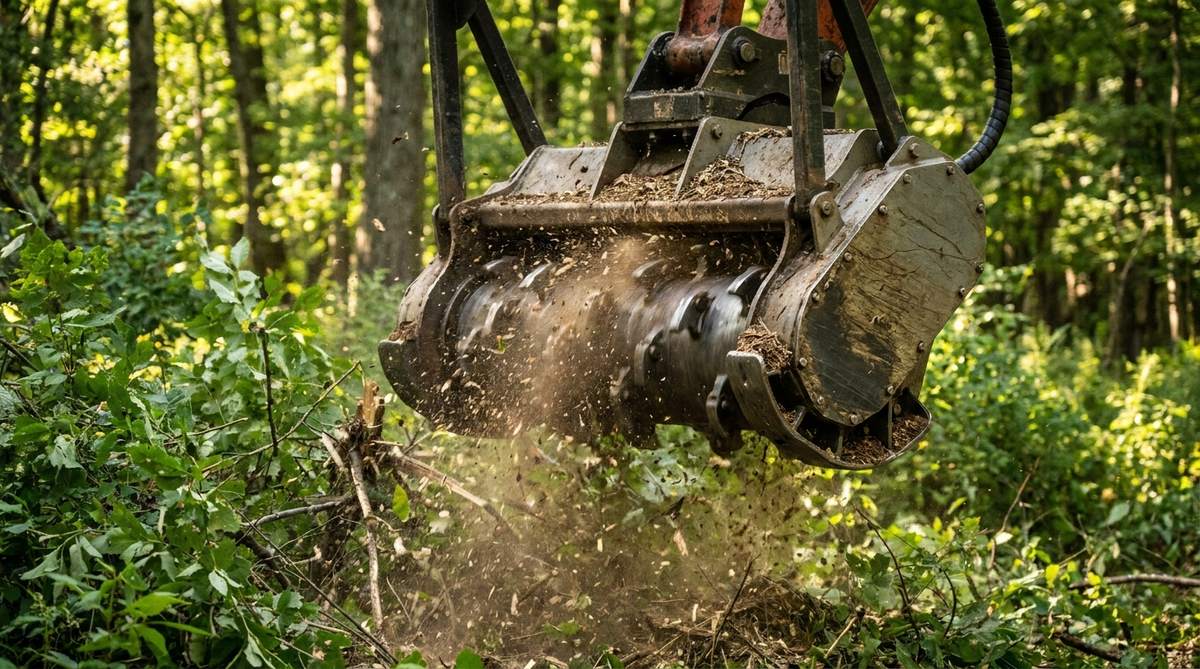
Where mulching earns its keep in one pass:
- Overgrown pasture and field edges. Reclaim ground without stripping it bare.
- Camp and cabin lots. Open shooting lanes, trails, and food plots in the northern tier.
- Slopes. The mulch mat holds soil on grades where bare-dirt clearing would wash.
- Tight-access parcels. One machine in, one machine out — no truck traffic across your yard.
What Forestry Mulching Costs
Published national ranges for machine-plus-operator work run about $100–$250 per hour, and land clearing overall publishes at $500–$5,600 per acre — mulching brush and saplings typically lands in the lower-to-middle part of that per-acre band. Why it trends cheaper than dig-and-haul clearing: there's no trucking, no disposal fees, no burn management, and no separate cleanup pass. The debris becomes the ground cover.
Density sets the hours, and hours set the price. Thin brush moves fast; a decade of hardwood regrowth doesn't. Those are published planning figures, not quotes — the full per-acre breakdown lives in our Pennsylvania land clearing cost guide, and a free site walk turns the range into a real number.
When Mulching in Place Beats Hauling It Off
If the land is staying land — pasture, trails, views, hunting ground, a buffer you mow twice a year — mulch-in-place is usually the better spend. You skip the two most expensive parts of conventional clearing: getting debris off the property and repairing what heavy truck traffic did to it. On sloped ground it has a second advantage: Williamsport country takes 40-plus inches of precipitation a year, and a mulch mat protects freshly cleared slopes from washing while bare-scraped dirt invites exactly the erosion problems you'd then pay to fix.
Haul-off earns its cost when appearance or construction is the goal: a homesite, a lawn, a lot going on the market. That's a land clearing conversation, and we do both — so the recommendation you get isn't shaped by the machine we happen to own.
The Honest Limits: Stumps Stay, and Mulch Takes About a Year
Forestry mulching does not remove stumps or roots — it grinds trees down to ground level and leaves the root systems in the soil. Anyone who tells you otherwise is selling something. The stumps are cut flush and hidden under chips, but they're there, and they'll send up shoots; expect some regrowth and plan on a maintenance pass or brush-hogging to keep reclaimed ground open.
The mulch layer itself takes roughly a year to decompose, feeding the soil as it breaks down. That's a feature on pasture and camp ground, and a nuisance if you wanted a seeded lawn next month — which is why we say so before you book, not after.
Can You Build on Mulched Land?
No — not on mulching alone. A building pad can't sit on buried root systems and a foot of decomposing chips; the ground under a foundation, driveway, or septic field has to be grubbed, compacted, and graded. If construction is anywhere in your plans, the honest path is conventional clearing with grubbing where the structures go, then grading and site preparation to cut the pad — with mulching, if you like, on the acreage around it.
Not sure which your project needs? Call (570) 435-7565 or send the details through the contact page — we'll walk the property and lay out both numbers side by side.