Water, Sewer, Electric & Conduit Runs
The job is one clean trench, cut to the depth the utility actually requires, bedded so the line survives, and backfilled so the yard doesn't remember it. We trench water services, sewer laterals, electric feeds, and conduit runs for new homes, replacements, garages, and outbuildings across Lycoming County.
Every utility wants something different from its trench — depth, bedding, cover, and slope all change with what's going in the ground — and the long rural runs this county specializes in punish shortcuts. A camp at the end of a 400-foot lane needs its water and power to arrive through ground that freezes hard and hides shale, which is exactly the ground we trench every week.
How Deep Do Water Lines Go? Frost-Depth Burial
Around Williamsport, water lines typically get buried about 36 inches deep — below frost — but the exact requirement on your job is set by the local code official, and that's the number we build to. There is no single official frost depth for the region: design figures from the Pennsylvania Housing Research Center run roughly 24 to 48 inches, which is why the code official's call matters.
The stakes are real here. Frost season runs from about mid-October to early May, and a line trenched shallow to save an hour of digging is a line that freezes during a January cold snap — leaving you thawing pipe in the coldest week of the year. We confirm the required depth with the municipality, trench to it, and document it, so the cheap shortcut never gets taken on your job.
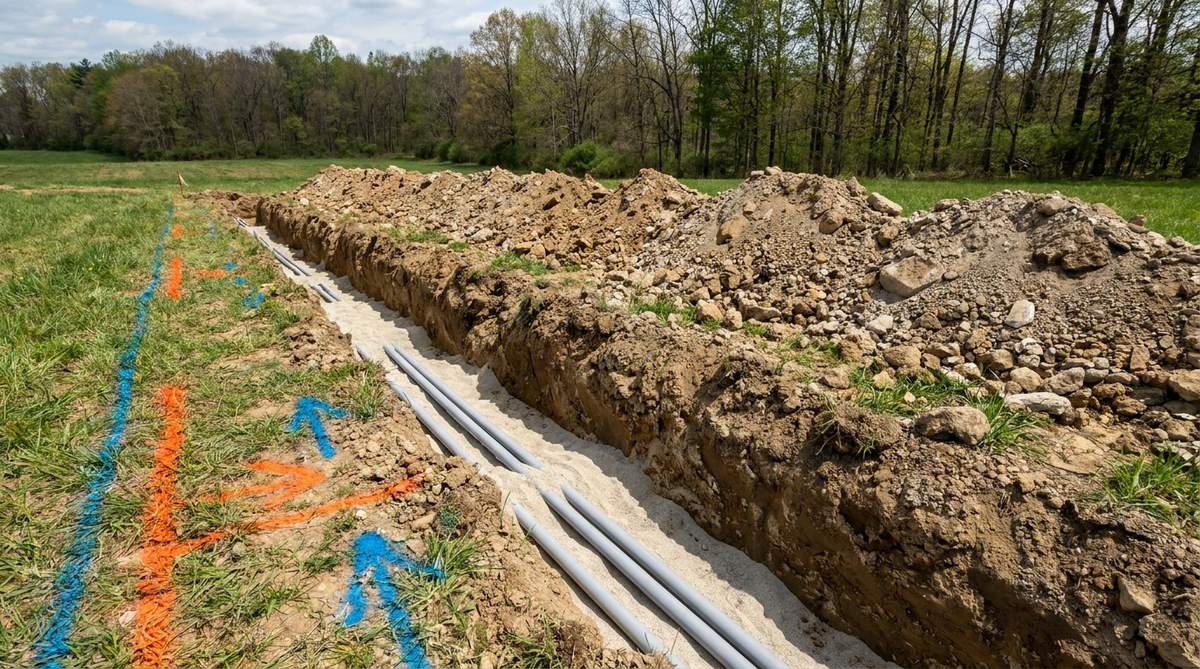
What a trench done right includes:
- Verified depth. Confirmed with the local code official, not assumed.
- Proper bedding. The line rests on prepared material, never on ledge or rubble.
- Utility marks first. The 811 locate is filed and marked before we cut.
- Clean backfill. Compacted in lifts so the lawn doesn't sink into a trench-shaped ditch next spring.
The 811 Call Is Ours to Make
Yes — someone must notify PA One Call (811) before any digging in Pennsylvania, and when you hire us, that someone is us. The law puts the filing on the excavator, not the homeowner, and Act 50 gives it enforcement teeth.
Here's how the process actually runs: we file the location request with PA One Call 3 to 10 business days before the dig, the utilities send locators to mark their buried lines in paint and flags, and only then does a bucket touch ground. That lead time is why a trenching job can't start "tomorrow" no matter who you hire — and why anyone who offers to is worth being suspicious of. One honest caveat: 811 marks the utilities' lines, not private ones past your meter, so we talk through where your own lines likely run during the site walk.
What Happens When the Trench Hits Shale
On upland lots here, don't ask if — plan on it. The Weikert soils that blanket Lycoming County's uplands put shale bedrock less than 20 inches below the surface, and a 36-inch water line trench goes through that rock, not over it.
This is what a "rock clause" in a trenching contract means: it defines how rock time gets billed if ledge appears — typically as hammer time on top of the base price — instead of pretending the rock isn't there. Published ranges add $200–$1,200+ when rock work enters a job. Our approach is to price the risk before it's a surprise: we assess ledge probability on the free site walk, tell you what the shale means for your particular run, and put rock handling in writing in the estimate. The quote that ignores rock isn't cheaper — it just bills you later.
Septic Tie-Ins & New Builds
Trenching rarely travels alone — most of our runs happen alongside a septic install or a new build, and bundling them saves a mobilization. If we're already on site placing a tank and field, the water service and electric conduit go in the same visit; if a foundation is being dug, the utility trenches get cut while the machines are there.
That's worth real money on rural properties and camps, where getting equipment to the site is a line item of its own. See septic system installation and basement & foundation excavation for the jobs trenching most often pairs with — or tell us the whole plan and we'll sequence it. Call (570) 435-7565 or use the contact page for a free site walk.