New farm and recreation ponds built to hold water — and silted-in ponds dredged back to real depth — with the permits handled before the first bucket.
Call (570) 555-0134Tell us what you're planning — a cleared lot, a dry basement, a new driveway, a septic replacement — and we'll walk the site, explain your options, and put a real number on it. Call (570) 555-0134.
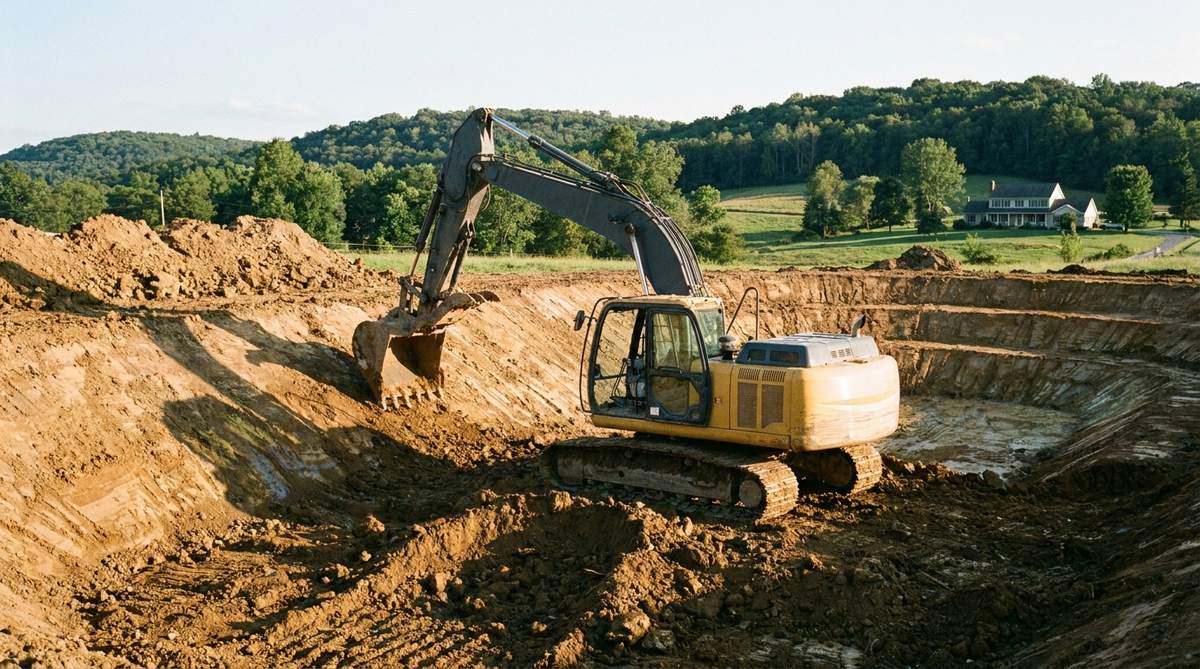
We build new ponds across Lycoming County — farm ponds for livestock and irrigation, recreation ponds for fishing and swimming, and wildlife ponds on hunting ground. In the largest county in Pennsylvania by land area — nearly 1,229 square miles — pond work is a regular part of our schedule, not a novelty.
A pond that lasts starts before the digging — in a county averaging more than 40 inches of precipitation a year, every pond eventually meets the storm that tests its spillway, and the ponds that survive it were planned around soil, slopes, and overflow from day one. Topsoil is stripped and stockpiled so the finished banks grow grass instead of weeds.
If your pond site is wooded, clearing comes first — see our land clearing page. Stumps and root mats have no place in a dam or berm, so we grub the basin clean rather than burying wood that rots, settles, and leaks later.
What a proper pond build includes, itemized on every estimate:
If your pond has gone from eight feet of water to three feet of muck, it doesn't need to be abandoned — it needs to be cleaned out. Every pond collects sediment from the watershed above it, and with 40-plus inches of precipitation a year washing soil downhill, a Lycoming County pond can lose half its depth over a couple of decades.
There are two honest ways to do it: drain or draw the pond down, let the bottom firm up, and dig it dry — the cheapest, most thorough cleanout — or work from the bank with a long-reach machine where draining isn't practical. Either way, wet spoil is the real cost driver: muck has to dewater before it can be spread or hauled, so where it goes on your land is one of the first things we settle on the site walk. A cleanout finishes with reshaped banks and a checked overflow.
Often, yes — it depends on where the pond sits and where its water comes from, and finding out after the fact is the expensive way. Ponds fall under the state's Chapter 105 water obstruction and encroachment rules when they involve streams, wetlands, or floodways, and the Lycoming County Conservation District — which publishes pond guidance for landowners for exactly this reason — is the right first stop.
Two more triggers catch pond builders by surprise. Disturb 5,000 square feet or more of earth — almost every pond does — and Pennsylvania requires a written erosion-and-sediment control plan; disturb an acre or more and an NPDES permit comes into play, both through the county conservation district. And if the site sits in a mapped floodplain, the county Planning department administers floodplain rules for 19 of our municipalities. We build the permit steps into the estimate and the schedule, not into a mid-project surprise.
A pond that holds water is sited, not just dug. Three questions decide almost everything: where the water comes from, whether the soil will seal, and how much watershed drains to the spot.
Water can come from springs, groundwater, or surface runoff — the goal is a supply that keeps the pond full through August without sending every thunderstorm over the spillway. Soil is the harder question here: much of our upland ground is Weikert and Berks channery silt loam weathered from shale — some of it seals, some of it leaks, and on the Weikert soils bedrock can sit less than 20 inches down. Test holes tell the truth before the machines arrive. Where native soil won't hold water, a compacted clay liner can fix it — but imported clay costs real money, and sometimes the honest recommendation is to move the pond two hundred feet rather than fight the site. Not sure what your ground will do? Ask us — a site walk answers it.
One of the most common posts from first-time pond builders, word for word: "Got my first quote back and the guy wants 30K — is this out of line?" The honest answer: not necessarily. A pond is one of the largest earthmoving projects a homeowner ever buys, and the math shows why.
Published national ranges put an excavator with operator at $100–$250 per hour, and typical residential excavation projects at roughly $1,700–$6,700 — but ponds routinely sit above that band on sheer volume. A one-acre pond dug to useful depth means moving thousands of cubic yards, which is weeks of machine time before anything else is counted. What separates a fair $30,000 quote from a padded one is the line items: does the spoil stay on site shaped into berms, or get trucked away? Does the number include the compacted core and a storm-sized overflow, or just a hole? Rock — which published ranges show adding $200–$1,200 or more when it turns up — and imported clay each move the total. Get itemized quotes and compare the work, not just the bottom lines.
If your site needs trees taken off first, that's its own line item with its own math — our Pennsylvania land clearing cost guide breaks down what that part should run per acre.
Clearing, grading, septic, drainage, or demolition — call now and get a real answer today, not a voicemail you never hear back from.
(570) 555-0134Published national ranges run $100–$250 per hour for an excavator with operator, and typical residential excavation projects publish at roughly $1,700–$6,700 — but a pond is mostly machine-hours and moved dirt, so most real pond builds land well above that typical band. The honest way to price one is a site walk: soil, access, spoil handling, and permits set the number, not the acre count alone.
There's no honest flat price for a one-acre pond. Dug to a useful depth it means moving thousands of cubic yards of material, which at published equipment rates of $100–$250 per hour represents weeks of machine time. The big swings are whether spoil stays on site shaped into berms or gets hauled away, whether the native soil seals or needs imported clay, rock, and access. An itemized quote that names each of those is the one you can trust.
Quite possibly. Ponds that involve streams, wetlands, or floodways fall under Pennsylvania's Chapter 105 water obstruction and encroachment rules; disturbing 5,000 square feet or more of earth requires a written erosion-and-sediment control plan; and an acre or more of disturbance triggers NPDES permitting — all of which run through the Lycoming County Conservation District, which publishes pond guidance for landowners. We identify what your site needs and handle the paperwork as part of the job.
It depends on three things: whether the pond can be drained and dug dry (significantly cheaper) or has to be dredged from the bank, how much muck has built up, and where the spoil can go on your property. At published equipment rates of $100–$250 per hour, a small drained cleanout is a far smaller job than a wet dredge with haul-off. We walk the pond, probe the sediment, and quote from what's actually in there.