Last updated
The Short Answer
Last updated July 2026.
Published national ranges put land clearing at $500 to $5,600 per acre, and most complete clearing projects total between $1,395 and $6,168. Light brush sits at the bottom of the band; dense mature woods with stump removal sit at the top. Your lot's density, slope, access, rock, and disposal plan decide where you land.
Everything on this page is a published national planning range, not a quote — Pennsylvania hillsides have a way of hiding the two most expensive surprises (shale ledge and steep grade) until someone actually walks the ground. Ours are free: call (570) 435-7565.
Land Clearing Cost Per Acre by Vegetation Density
Density is the single biggest price driver, so the published $500–$5,600 per-acre band breaks down roughly like this:
| What's on the land | Published per-acre range | What the work looks like |
|---|---|---|
| Overgrown grass & light brush | $500 – $2,000 | Mowing-class clearing; a mulcher or brush cutter, one pass |
| Dense brush & saplings | $1,500 – $3,400 | Heavier mulching or dozer work; small stems, big volume |
| Lightly wooded (scattered trees) | $2,800 – $4,500 | Selective felling plus brush; debris handling starts to matter |
| Heavily wooded lot | $4,000 – $5,600+ | Full felling, grubbing, and disposal; the top of the band |
Two footnotes belong on every row. First, typical complete projects — the whole job, not just the per-acre math — run $1,395–$6,168 in published national data, because most residential clearing jobs are one to three acres with setup and disposal spread across them. Second, rock work adds $200–$1,200+ where machines meet ledge, and on the Weikert soils that cover Lycoming County's uplands, shale bedrock can sit less than 20 inches down. What clearing actually includes — and where it ends — is on our land clearing service page.
The Five Factors That Decide Where You Land
Two identical-acreage lots can sit at opposite ends of the published band, and five factors explain the gap.
- Density. A brushy field and a mature woodlot are different jobs wearing the same acreage.
- Slope. Wooded hillsides here commonly run 25% and steeper — machines work slower, and erosion controls stop being optional.
- Access. A lot you can drive a truck onto costs less than one we have to cut a path into.
- Rock. Shallow shale ledge is the region's signature surprise; published ranges add $200–$1,200+ when rock work enters.
- Disposal. Piling on site is cheapest, burning depends on the township, grinding keeps the debris as mulch, and hauling off is the cleanest finish and the biggest line item.
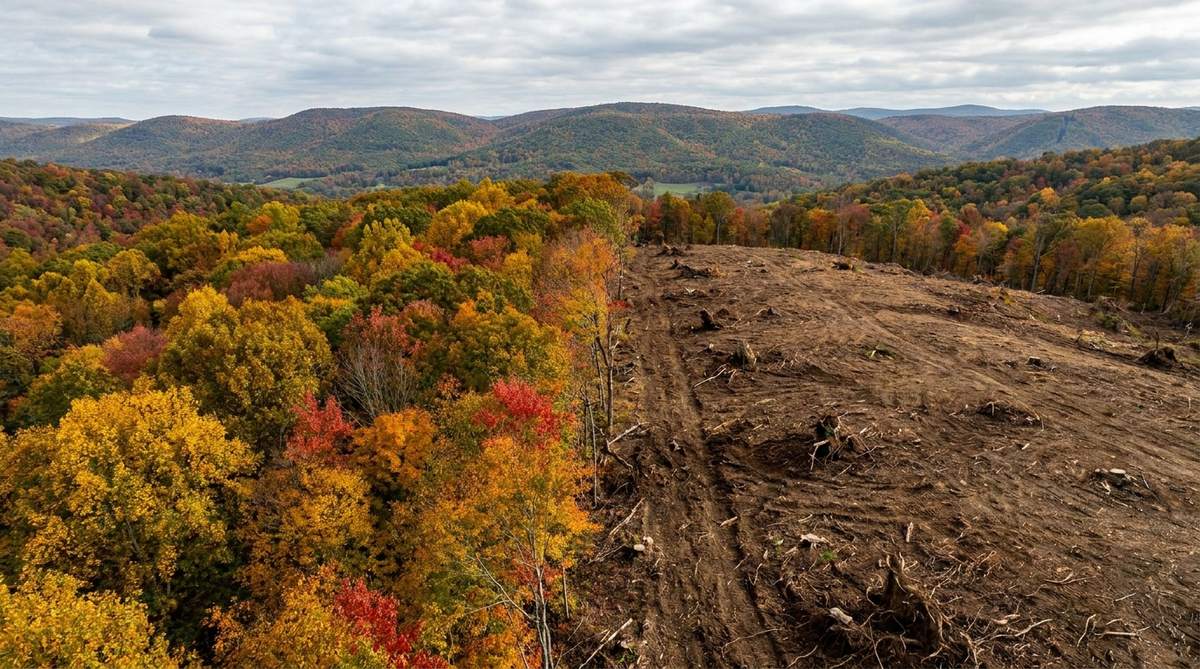
Why One Quote Says $3,500 and the Other Says $12,000
Because the two contractors aren't pricing the same job — they're pricing different assumptions about the same land. This is the most common land-clearing anxiety there is, and the gap is almost never dishonesty. It's scope. Here's what each bid probably assumed:
- Stumps. The $3,500 bid cuts them flush and leaves them; the $12,000 bid grubs out stumps and root balls and backfills the holes. Grubbing is the difference between "looks cleared" and "ready to build."
- Disposal. The low bid piles debris on site or assumes the township allows burning; the high bid loads and hauls every stick, with trucking and disposal fees riding on top of machine time.
- Rock. The low bid carries no rock allowance and bills hammer time later if ledge appears; the high bid prices the shale in up front.
- Erosion controls and permits. The low bid leaves the erosion-and-sediment plan, silt fence, and permit filings to you; the high bid includes them.
- Finish. The low bid drives away when the trees are down; the high bid includes rough grading so the lot sheds water and is ready for the builder.
Add those five lines to a $3,500 base scope and you've built the $12,000 quote — for genuinely more job. The defense is simple: insist every bid is itemized, then compare line by line instead of bottom line by bottom line. That's how ours come by default.
Forestry Mulching vs. Dozer Clearing: Which Costs Less?
For brush and saplings on land you're not building on, mulching usually wins — because the disposal line item disappears entirely. A forestry mulcher grinds vegetation where it stands into ground cover, so there are no burn piles, no haul trucks, and no tipping fees, and the topsoil never gets scraped. Mulching work is commonly priced by the hour; published national ranges put machine-with-operator time at $100–$250 per hour, and the total tracks how dense the growth is.
Dozer clearing carries more line items — felling, grubbing, disposal, and usually rough grading — but it's the straighter path when construction is the goal, because mulched land still holds its stumps. If you'd have to come back and grub the footprint anyway, paying for mulching first is paying twice. The honest rule: mulch for views, trails, pasture reclamation, and fire breaks; clear and grub for anything with a foundation, a driveway, or a septic field on it. Full comparisons live on our forestry mulching and land clearing pages.
When Permits Add Cost: 5,000 Square Feet and One Acre
Two statewide thresholds can add real cost to a clearing budget, and both arrive faster than most owners expect. Under Pennsylvania's Chapter 102 erosion and sediment control rules (PA DEP), disturbing 5,000 square feet or more of earth — barely an eighth of an acre — requires a written E&S plan. Disturb an acre or more and an NPDES permit comes into play, administered through the county conservation district.
Almost every real clearing job crosses the first threshold, and plenty cross the second. What that means in dollars: plan preparation, silt fence and other controls installed and maintained, and permit fees and review time on the NPDES tier — costs a low bid quietly leaves out and an inspection can expensively add back in. We build the plan, the controls, and any permit costs into the estimate up front, and we file the PA One Call (811) request before any ground is opened.
What This Means for Your Lot
Published ranges get you a budget; a site walk gets you a price. If the lot is in Williamsport or anywhere in Lycoming County, we'll walk it free, tell you which row of the table you're actually in, flag the slope, rock, and permit factors before they're surprises, and hand you an itemized number you can compare against anyone. If the plan includes a building pad afterward, grading & site preparation happens in the same mobilization. Call (570) 435-7565 or use the contact page.