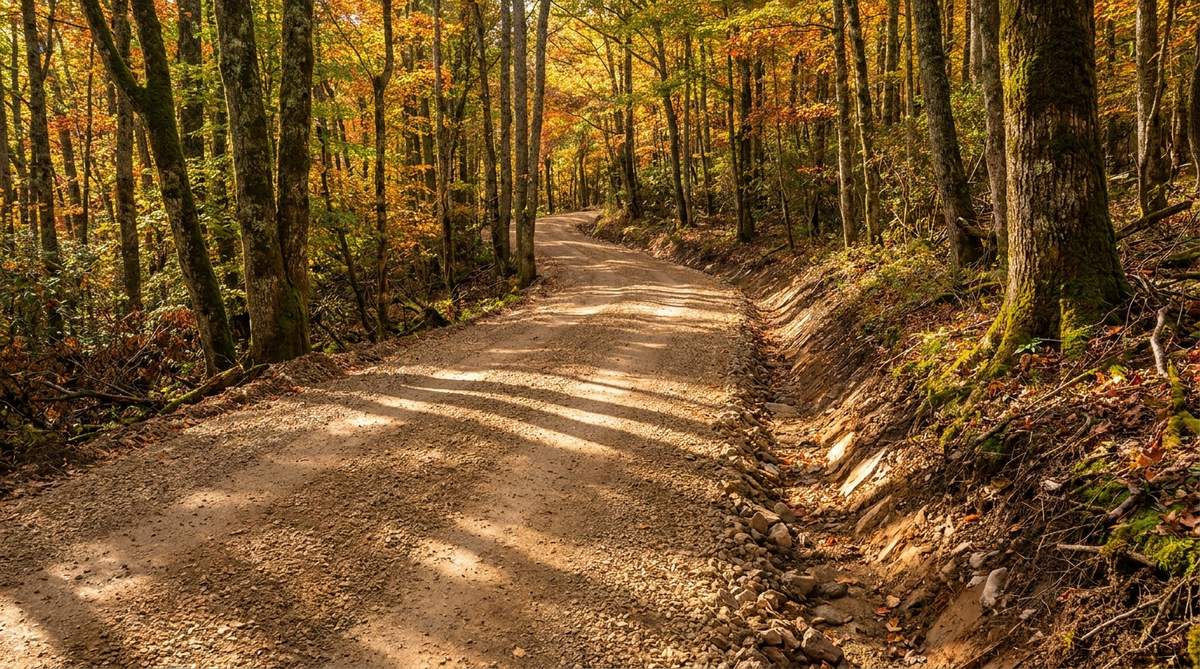
New gravel driveways built in layers that last — and washed-out, rutted, frost-heaved lanes rebuilt so they stop failing every spring.
Call (570) 555-0134Tell us what you're planning — a cleared lot, a dry basement, a new driveway, a septic replacement — and we'll walk the site, explain your options, and put a real number on it. Call (570) 555-0134.
A gravel driveway that lasts isn't a load of stone dumped on dirt — it's built in compacted layers: a stripped and shaped subgrade, geotextile fabric where the ground runs soft, a base course of larger crushed stone, and a surface course of angular stone with fines that locks up under traffic. Build it that way once and you top-dress it every several years. Skip the layers and you buy the driveway again every spring.
Every new install starts the same way: we strip the topsoil (it never belongs under a driveway), cut the lane to grade, and study where water wants to go before a single truckload arrives. On soft or wet ground we roll out geotextile fabric so base stone can't pump down into the mud — the cheapest insurance a gravel drive in this county can have. The base goes down in compacted lifts, the surface stone gets bladed to a crown, and the whole section is rolled tight. We file the PA One Call (811) request before any cutting; that's our responsibility, not yours.
Building a driveway for a new home or camp? It pairs naturally with the rest of the dirt work — see grading & site preparation and utility trenching — one mobilization instead of three.
Most rutted, washboarded, potholed gravel driveways don't need new stone — they need their shape back. Regrading pulls the stone traffic has pushed to the edges back into the lane, re-cuts the crown, fills holes from the bottom, and compacts everything into a hard running surface.
Potholes are a water problem in disguise: each one holds a puddle, every tire through the puddle pumps fines out of the hole, and the hole grows. Blading the surface smooth without restoring the crown is a two-month fix at best. We regrade the profile so water sheds, then add fresh surface stone only where the section is genuinely thin — you shouldn't pay for stone you don't need.
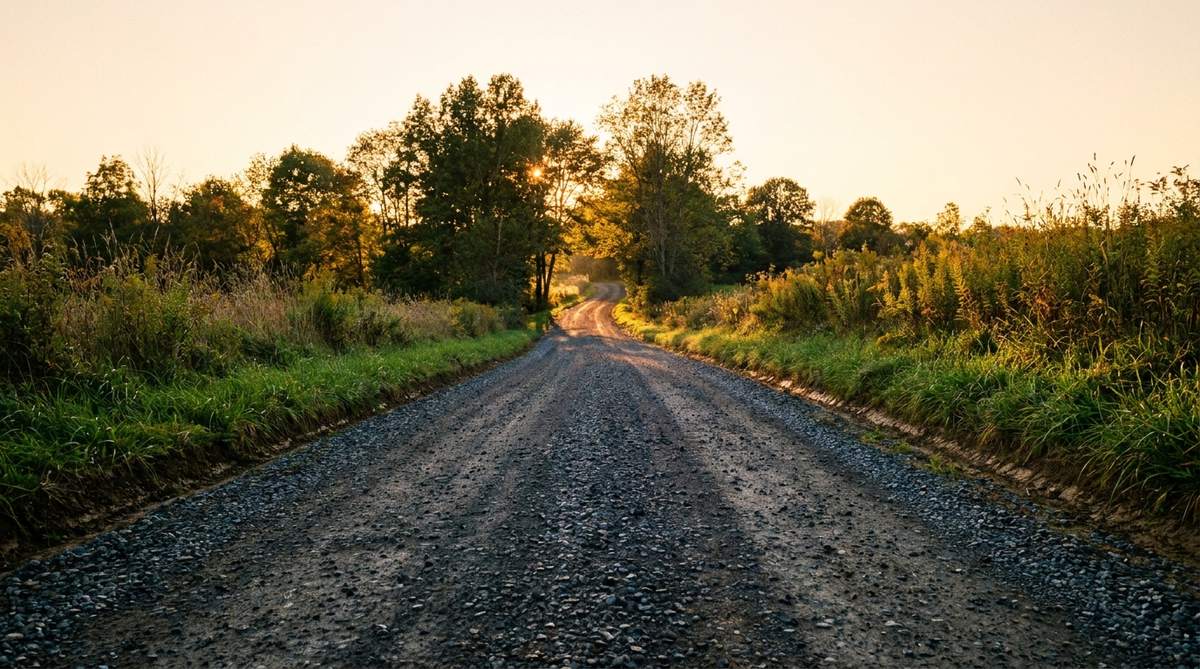
What a proper rebuild includes, itemized on every estimate:
A washout is a drainage problem wearing a gravel disguise: water is running down your driveway instead of off it, and it will keep taking stone with it until the path of the water changes. That's why pouring anything on a washing lane — more gravel, finer gravel, "better" gravel — only resets the clock.
On slopes we fix washouts with shape and structure: a crown so rain leaves the surface fast, a ditch along the uphill edge to intercept hillside runoff, culverts to carry ditch water under the drive instead of across it, and broad-based dips on steep camp lanes that shed water in stages instead of letting it gather speed. Williamsport averages more than 40 inches of precipitation a year — a sloped lane here handles serious water, and the driveways that survive are the ones built to route it.
Frost heave is water trapped in the driveway base freezing, expanding, and lifting the surface — then thawing into the soft, rutted mess every camp owner knows as mud season. Keep water out of the base and the heaving stops.
The freeze season here runs roughly mid-October to early May, and design frost depths published for our region by the Pennsylvania Housing Research Center run about 24 to 48 inches — confirm your site's requirement with the local code official. A gravel drive can't be built below frost, so it has to drain instead: crowned surface, open ditches, fabric separating the base from wet subgrade, and clean compacted stone that passes water rather than holding it. That's the difference between a lane that firms up in March and one you can't trust until May.
We build and maintain the long private lanes and camp roads Lycoming County is full of — the quarter-mile drives where every material decision gets multiplied by a thousand feet.
On long lanes we stage the work by what pays back first: drainage before stone, because ditching and culverts protect every dollar of gravel that follows; full base rebuilds only where sections are actually failing; and a top-dress across the rest. Camp owners up the Lycoming Creek corridor and in the northern tier — we schedule lane work alongside other camp jobs, like pads and trenching for water or power, so you pay for one mobilization, not three.
Published national ranges put gravel driveways at $1.25 to $4.00 per square foot installed. By that math a typical 12-foot-wide, 60-foot residential drive (720 square feet) lands around $900–$2,900, and long rural lanes run into the thousands — see the 300-foot example in the FAQ below.
What moves the number inside that range: subgrade (soft, wet ground needs fabric and more base), drainage structures (the ditching and culverts that keep the rest of the money in place), stone depth, truck access, and rock — published ranges show rock excavation adding $200–$1,200 or more when ledge turns up, and on our shale hillsides it does. Our estimates carry each of those as its own line item, so you can see exactly what you're paying for and what you can phase for later.
If your driveway meets a state road, Pennsylvania requires a Highway Occupancy Permit (HOP) from PennDOT before it connects — and several local townships require a driveway permit of their own. We handle both filings as part of the job.
HOPs for Lycoming County go through PennDOT Engineering District 3 in Montoursville, and the application should go in at least 30 days before you need to build. Connect without one and the fine starts at $100 — plus the real risk of tearing out and rebuilding the entrance to PennDOT's specification. Closer to home, Old Lycoming Township and Loyalsock Township both require driveway permits, and other municipalities have their own rules. Reviewers look at sight distance, entrance grade, and culvert size — exactly the things a driveway needs anyway, so we build them to pass the first inspection.
Not sure whether your road is state or township? Ask us — we can usually tell you in one phone call.
Clearing, grading, septic, drainage, or demolition — call now and get a real answer today, not a voicemail you never hear back from.
(570) 555-0134Change where the water goes, not the stone. A gravel driveway holds its surface when it's crowned so rain sheds sideways, ditched so hillside runoff never reaches the lane, and culverted where water has to cross. Angular crushed stone with fines locks tight once compacted; round stone rolls away no matter what you top it with. We rebuild the shape first — that's what actually stops the washing.
Honest answer: nothing you pour on top will fix it, because a washout is a shape problem, not a material problem. Water is running down the lane instead of off it. The fix is a regraded crown, a ditch along the uphill side, and a culvert or broad-based dip where the flow crosses — then a top course of crushed stone that compacts. New gravel poured on the old shape washes out on the same schedule the last load did.
Published national ranges run $1.25–$4.00 per square foot installed. At a typical 10–12 feet wide, a 300-foot drive is 3,000–3,600 square feet — roughly $3,750 to $14,400 by the published math. Subgrade condition, drainage structures, and rock decide where in that range a real quote lands, which is why we walk the lane before we price it.
You can — once. Round river gravel and bank-run fill don't lock together, so traffic pushes them into the mud and the ruts come back by spring. Angular crushed stone with fines compacts into a surface that actually carries weight. The five-year math almost always favors building the base correctly once, then top-dressing cheaply after that.
Frost heave means water is trapped in your driveway base: it freezes, expands, and lifts the surface, then thaws into spring mud. Design frost depths published for our region by the Pennsylvania Housing Research Center run roughly 24 to 48 inches — confirm your site's number with the local code official — and the freeze season here stretches from about mid-October to early May, so a wet base gets worked all winter. The fix is drainage: crown, ditches, fabric under the base, and clean compacted stone — not more gravel on top.