Building Pads & New-Home Site Prep
A building pad is the one part of your new home nobody ever sees — and everything sits on it. We cut and fill to the plan elevation, compact in lifts, and rough-grade the surrounding site so it sheds water while it waits for your builder, giving you a pad that's ready to form on the day we pull off.
What makes site prep here different is what's underneath. On the Weikert soils that cover Lycoming County's uplands, shale bedrock can sit less than 20 inches below the surface — so a pad that pencils out as a simple cut on paper can turn into rock work without a plan for it. We assess ledge risk during the free walk-through and put rock handling in writing, so the price you compare is the price you pay. Starting from standing woods? We take lots from trees to finished pad in one mobilization — see land clearing.
Finish Grading
Finish grading is the last machine pass on a project, and it decides whether your lawn drains, your topsoil stays, and your yard is actually usable. We respread the stockpiled topsoil, work out the ruts and low spots construction leaves behind, and hand the site back smooth and ready for seed.
The number that matters is fall — the ground should drop steadily away from the foundation, not pond against it. In a valley that takes more than 40 inches of precipitation a year, "flat" is not a finished grade; positive drainage is. Every finish grade we cut is checked against where the water will actually go in the first real storm.
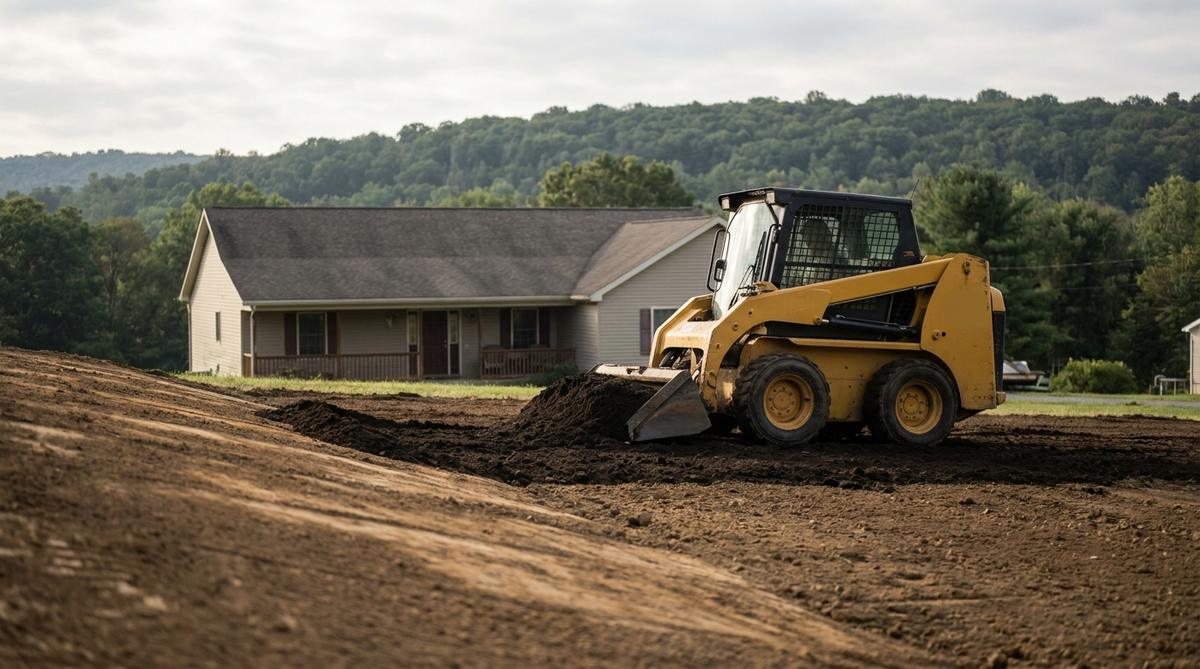
What a proper grade buys you:
- Dry foundation. Stormwater moves away from the house instead of soaking down the walls.
- Living topsoil. Stripped first, respread last — grass grows in soil, not subsoil.
- No re-dos. Compacted lifts under pads and fills mean nothing settles later.
- A yard you can mow. Smooth, steady fall — no washboard, no scalping, no swamp corner.
Yard Leveling on Slopes
Yes, a sloped backyard can almost always be leveled — the real question is how much flat ground you want to buy. This is ridge-and-valley country, and hillside lots here commonly run 25% and steeper, so most "level my yard" projects are really a bench cut: dig into the high side, fill the low side, and shape the transition so it holds.
Balancing cut and fill on site keeps trucking off the invoice, and how big a bench we can cut depends on how close the shale sits under your particular slope. We'll show you the trade-offs on the walk — a full-width terrace, a smaller level pad for a pool or playset, or a gentler regrade that makes the whole yard usable without moving half the hill.
What Grading Costs Around Williamsport
Published national ranges put an excavator with operator at $100–$250 an hour, and most residential grading projects land between roughly $1,700 and $6,700. That band is wide because grading is priced by how much dirt moves, not by the square foot — a gentle backyard that balances its own cut and fill sits near the bottom, while a hillside bench that needs material trucked in sits near the top.
| What drives the number | Published range | Why it moves |
|---|---|---|
| Excavator & operator, hourly | $100 – $250 / hr | The base rate most grading work is billed against |
| Typical residential grading project | $1,700 – $6,700 | Where most yard-leveling and site-prep jobs land |
| Shale ledge or rock in the cut | +$200 – $1,200+ | Ridge-and-valley lots hit rock; breaking it is extra time |
Three things decide where you land. Cut-and-fill balance is the big one — if the dirt we take off the high side fills the low side, trucking never hits the invoice, and that single factor is usually what separates the bottom of that band from the top. Rock is the local wildcard: how close the shale sits under your slope is not knowable from the road, which is why we walk it before quoting. And disturbance area can add a regulatory step — cross 5,000 square feet and Chapter 102 requires a written erosion-and-sediment plan; cross an acre and NPDES permitting comes in through the county conservation district.
Anyone who gives you a grading price over the phone is guessing at all three. The site walk is free, and it is the only way to turn these ranges into a real number — call (570) 435-7565 or send the details through our contact page. For the full per-acre picture on wooded lots, our Pennsylvania land clearing cost guide breaks the clearing side down separately.
Regrade or French Drains?
If water runs across your yard, regrade. If water sits in it or rises from below, drain. That one distinction settles most of the "grade or drain" question homeowners call us with — surface water is a shape problem, and reshaping the ground fixes it at the source.
The stubborn yards need both: a regrade to move the storm flow plus a buried drain to collect what soaks into our slow-draining valley soils. Because we do both, you get the fix the water calls for — not the one a drain company or a landscaper happens to sell. The full comparison lives on our yard drainage & french drains page.
When the Yard Slopes Toward the House
A yard that pitches toward the house aims every storm at your foundation — and the fix is rebuilding the grade, not piling dirt against the siding. Mounding soil up the wall traps moisture against the structure and can bury the very features that keep water out.
The right repair reverses the fall in the critical first stretch around the foundation, then gives the redirected water somewhere legitimate to go — usually a shallow swale that carries it around the house and releases it downhill. Where roof water is part of the problem, downspout extensions get tied into the same plan so the whole system works together. It's a one-to-two-day job on most lots, and it's dramatically cheaper than the basement repairs it prevents.
Do You Need a Permit to Regrade Here?
Sometimes — and the honest answer is that it depends entirely on your township. Many local ordinances use rules of thumb like 2,500 square feet of disturbance or cuts and fills over 24 inches before a grading permit applies, but every township is different — so we check your municipality's rules and handle the paperwork as part of the job.
Two thresholds apply statewide no matter where you live: disturb 5,000 square feet or more of earth and Pennsylvania's Chapter 102 rules require a written erosion-and-sediment plan; disturb an acre or more and NPDES permitting comes into play through the county conservation district. Lycoming County's planning department administers zoning and floodplain rules for 19 of the county's municipalities, so the requirements really can change from one side of a road to the other. We confirm before we cut. Ready for a number? Call (570) 435-7565 or send the details through our contact page.